.jpg)
WELCOME TO THE PACIFIC SOCIOLOGICAL ASSOCIATION |
PSA 2026 Featured Speakers
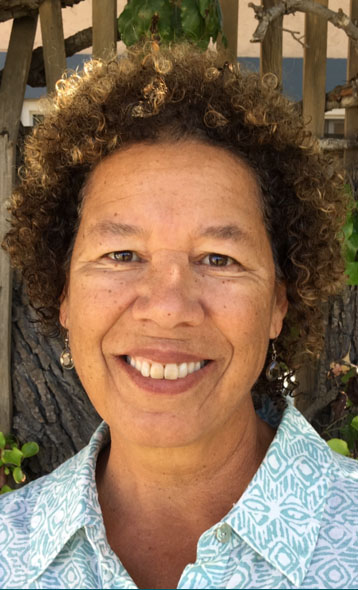
Sharon Elise, Ph. D.
PSA 2026 Presidential Plenary Speaker
Sharon Elise left a position in Women’s Studies at Fresno State to join the faculty of CSU San Marcos as Assistant Professor of Sociology in Spring 1994. Her teaching and research center on critical race studies, Black Studies, Black feminism, Intersectionality, women of color and sociopoetics. She has been active in the university and her discipline, and has held leadership positions in her department, college, academic senate, faculty union, and professional organizations. Learn more about Dr. Elise, including the full scope of her education, honors, awards, writings, poetry, scholarly achievements and her Curriculum Vitae on her CSUSM Faculty Page.

Theresa Gregor, Ph. D.
PSA 2026 Presidential Plenary Speaker
Theresa Gregor (Kumeyaay & Yoéme) is Associate Professor and Director of American Indian Studies at CSU Long Beach (Cal State Puvungna) located on unceded Tongva land. Her research and community work center California Indian women, rematriation, sovereignty, cultural revitalization, and place-based resilience through practices such as cultural burning. She is active in Tribal governance and advocacy as a policy consultant, nonprofit liaison, and founder of Mataguay Consulting Services LLC. Her current projects include the Collaboration of Native Nations for Climate Transformation and the Mellon Foundation’s Expanding and Affirming Ethnic Studies in the CSU.

Jared D. Aldern, Ph. D.
PSA 2026 Presidential Plenary Speaker
Jared D. Aldern is a fire practitioner and independent scholar. A descendant of Norwegian and German immigrants to the United States, he grew up in South Dakota, has lived in Upstate New York and San Diego County, California, and now resides in Central California. Retired from educational and Tribal government staff careers, he conducts historical research, writes grants and helps develop programs for Tribes, and works with many partners to burn and restore land.

Mary Shi, Ph. D.
PSA 2026 and Sorokin Lecturer - Sponsored by the ASA Sorkin Lecture Grant
Mary Shi is an LSA Collegiate Fellow and incoming Assistant Professor of Sociology (starting Fall 2026) at the University of Michigan–Ann Arbor. Mary earned a PhD in sociology at the University of California, Berkeley. Her research examines the intersection of land, the emergence of the modern state, and what we have come to call the economy. As part of the Anti-Eviction Mapping Project, she is author of Counterpoints: A San Francisco Bay Area Atlas of Displacement and Resistance (Oakland, CA: PM Press, 2021). Her award winning research and writing has been supported by the National Science Foundation, the San Francisco Arts Commission, and the University of California Institute on Global Conflict and Cooperation, among others. Her work has been in appeared in venues such as Politics & Society, ACME: An International Journal of Critical Geographies, Environment & Planning D: Society and Space, the Berkeley Journal of Sociology, and Contemporary Sociology.

C. Matthew Snipp, Ph. D.
PSA 2026 STAR Speaker Series - Sponsored by the Emeritus and Retired Sociologists Committee
C. Matthew Snipp is the Burnet C. and Mildred Finley Wohlford Professor of Humanities and Sciences in the Department of Sociology at Stanford University. He is also the Director for the Institute for Research in the Social Science’s Secure Data Center and formerly directed Stanford’s Center for the Comparative Study of Race and Ethnicity (CCSRE). Before moving to Stanford in 1996, he was a Professor of Sociology at the University of Wisconsin -- Madison. He has been a Research Fellow at the U.S. Bureau of the Census and a Fellow at the Center for Advanced Study in the Behavioral Sciences. Professor Snipp has published 3 books and over 70 articles and book chapters on demography, economic development, poverty and unemployment. His current research and writing deals with the methodology of racial measurement, changes in the social and economic well-being of American ethnic minorities, and American Indian education. For nearly ten years, he served as an appointed member of the Census Bureau’s Racial and Ethnic Advisory Committee. He also has been involved with several advisory working groups evaluating the 2000 census, three National Academy of Science panels focused on the 2010 and 2020 censuses. He also has served as a member of the Board of Scientific Counselors for the Centers for Disease Control and the National Center for Health Statistics as well as an elected member of the Inter-University Consortium of Political and Social Research’s Council. He is currently serving on the National Institute of Child Health and Development’s Population Science Subcommittee. Snipp holds a PhD in Sociology from the University of Wisconsin—Madison.